Homunculus Portfolio Canvas Experience
A high-end creative portfolio featuring a full-screen WebGL canvas, immersive scroll-triggered transitions, and a JavaScript-driven project list gallery.

Overview
This project features a sophisticated WebGL-based portfolio for a Japanese creative agency, utilizing a full-screen canvas to create a fluid, immersive digital experience. It is a premier reference for builders looking to master cinematic web design, specifically in how it bridges the gap between raw data storage (the hidden project list) and high-fidelity visual rendering.
Design System
- Color Palette & Visual Hierarchy: The aesthetic is strictly minimalist and dark-mode, utilizing a deep black background (
#000000) and subtle gray guide lines (.bg-line-set). Hierarchy is established through motion and light rather than color, with high-contrast white text reserved for critical project titles. - Typography System: A dual-language approach featuring sans-serif Japanese characters paired with modern English typography (
.t-cov-title.en). The UI uses scaled numbers (#t-cov-num) and small-caps labels to provide a refined, technical feel. - Page Structure & Flow: The site uses a non-traditional layout where content is loaded into a hidden data wrapper (
.dt-contents) and then projected onto the<canvas id="world">. The flow moves from a loading sequence (#loading) into a scrollable canvas experience, supported by a persistent header (#header-set) and a minimalist footer. - Reusable Components:
- Project Data Wrapper: The
.dt-workclass structure is an excellent model for organizing metadata (images, paths, and translation strings) that can be accessed by a JS engine. - Custom Transition Overlays: The
#transition-covercomponent includes a progress bar (.t-cov-barIn) and dynamic text blocks capable of transforming based on the active state. - Loading Bar: A sleek, horizontal loading indicator (
.loading-bar-in) that sets a high-end tone immediately upon entry.
- Project Data Wrapper: The
- Interaction & Motion Patterns: The experience is driven by "immersive scrolling," where vertical movement triggers WebGL transitions. Key interactions include the horizontal scroll tracker (
.top-scroll-line-in) and the animated hamburger menu (.header-humb) which uses matrix transformations for positioning. - Implementation Clues: The HTML reveals a heavy reliance on absolute positioning for layout components and a dedicated scroll container (
#scroll-wrapp) set to a dynamic height to proxy the user's scroll position to the WebGL world.
Use Cases
- Who Should Clone This: Creative developers and boutique agencies looking to build "award-worthy" portfolios that emphasize visual storytelling over standard grid layouts.
- Remix Directions: Replace the WebGL engine with a library like Three.js while keeping the HTML data structure (
.dt-work) to populate the scene. One could also remix the#transition-coverlogic for more traditional multi-page sites to create seamless "PJAX-style" transitions. - Suggested Clone Scope: Start by cloning the HTML data wrapper and the loading sequence for a high-impact intro. A full-page clone is recommended only for developers comfortable with JavaScript-heavy animation orchestration, while the UI elements like the
.top-scroll-txtand.bg-line-setare great for quick, isolated section remixes.
Related Inspirations

OHZI Interactive Studio WebGL Showcase
A high-performance interactive portfolio featuring WebGL/Three.js environments, smooth section transitions, localized video case studies, and a progress-bar navigation system.
Unseen Studio Immersive Digital Portfolio
An interactive studio site featuring Three.js 3D backgrounds, custom animated cursors, smooth scroll containers, and high-fidelity motion-driven button transitions.
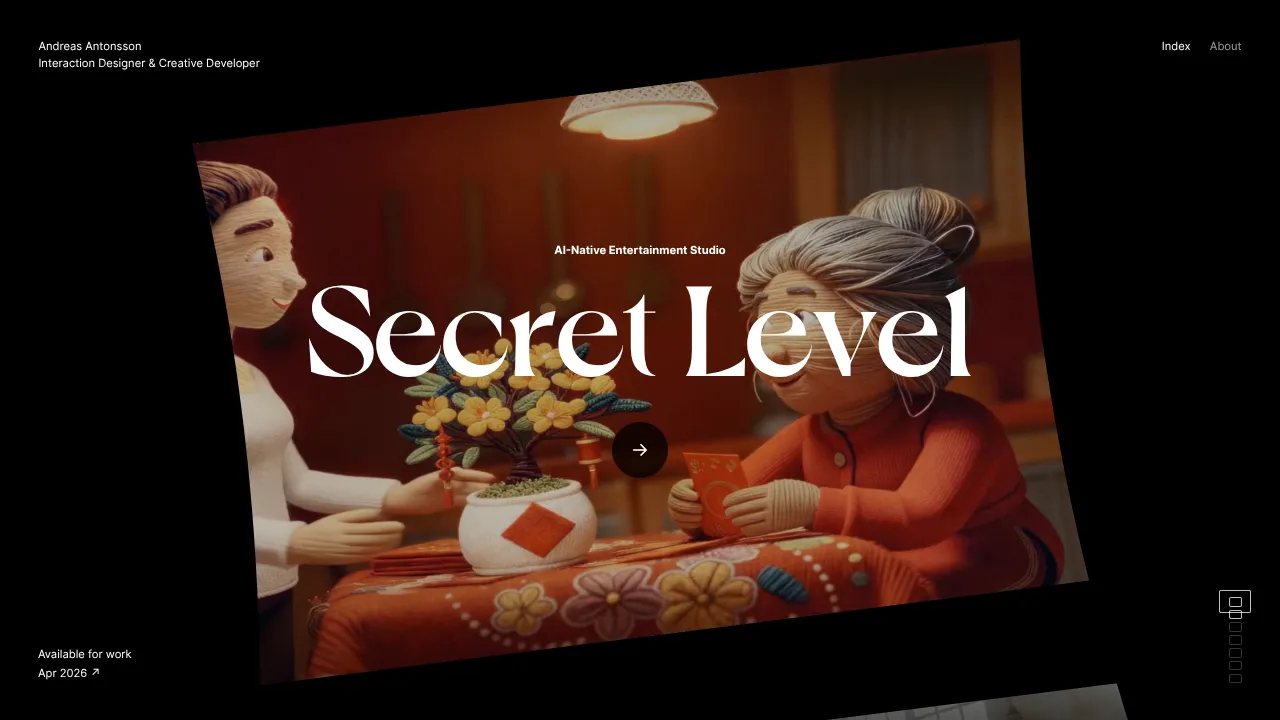
Andreas Antonsson Immersive Portfolio Gallery
A Three.js-powered creative portfolio featuring a curved 3D project carousel, scroll-synchronized background textures, and distinctive typography layouts for high-impact showcases.
SavoirFaire Holistic Studio Portfolio Hero
A high-concept dark mode landing page featuring a Three.js WebGL background, interactive custom cursor, marquee animations, and a numerical preloader.

Julien Renau WebGL Portfolio Portfolio
A high-performance creative technologist portfolio featuring horizontal video carousels, text-stroke animations, and an award-winning project grid built with Nuxt.js and GSAP.

Phantom Creative Agency Landing Page
Minimalist dark-mode hero layout featuring a sound-enabled interaction overlay, monochrome cookie banner, and accessible screen-reader-optimized content architecture.
